Google’s November 2026 Core Update
Google’s November 2026 core update started rolling out on November 10, 2026, and Google said the rollout may take up to two weeks to complete. For business owners, marketing leaders, and SEO teams, that means rankings and organic traffic may fluctuate before the update fully settles. Some changes may look important right away. Others may fade once the rollout is complete and search results stabilize.
This is the third Google core update of 2026, following the March 2026 and May 2026 core updates. The May 2026 core update finished on June 2, 2026, more than five months before this rollout began. Google has not named a narrower target for this release. Google described the November update as a regular update designed to better surface relevant, satisfying content for searchers across all site types. If your traffic changes during this period, the cause may not be a single ranking factor or a single page-level issue.
The right response is measured, not rushed. A Google algorithm update can affect rankings, impressions, clicks, and conversions, but the best teams separate noise from real performance shifts. They look at page groups, query types, leads and revenue, and search result changes before making major content or site decisions. That approach protects the work already performing well while helping you find pages that need attention.
Google’s Search Status Dashboard entry for the update, which began on November 10, 2026, at 10:06 a.m. Pacific Time, reads: “Released the November 2026 core update, which applies globally and to all languages. The rollout may take up to 2 weeks to complete.” See the official incident on the Google Search Status Dashboard. Google’s dashboard still listed the update as Active as of 7:29 a.m. Pacific Time on November 11, 2026, and Google Search Central said it will update the ranking release history page when the rollout is complete.
What the Google November 2026 Core Update Means
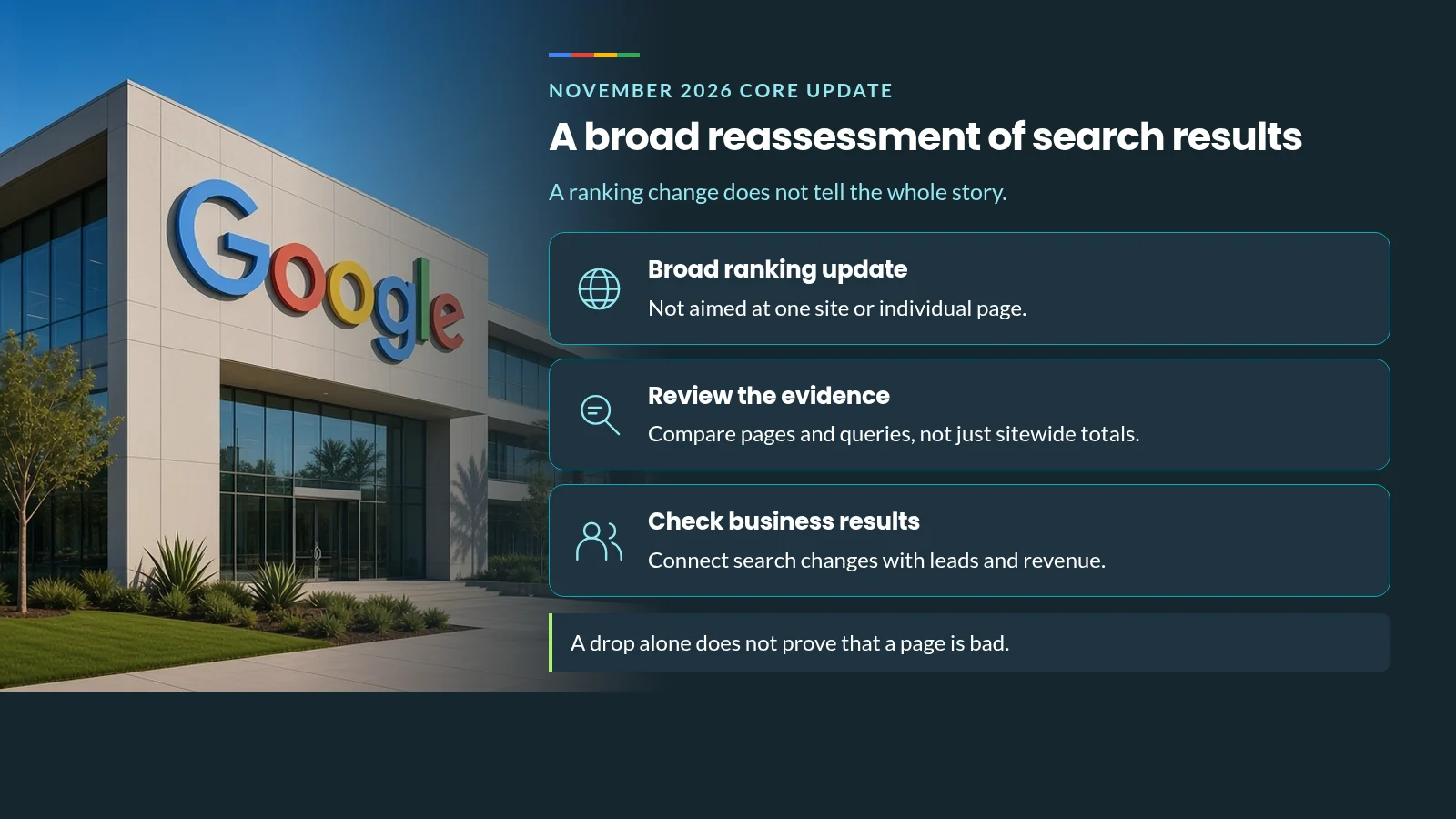
The Google November 2026 core update is a broad ranking update, meaning it is not aimed at a single website, industry, or technical issue. Google core updates adjust how Google’s systems evaluate content across the web. When those systems change, some pages gain visibility, some lose visibility, and many see little real movement. Google has not described this November release as a change aimed at one kind of site.
For businesses, the main point is simple: a broad core update usually reassesses how well your content matches search intent, trust, usefulness, and overall page quality compared with competing results. That does not always mean a page that drops is bad. It may mean Google now sees another page as a better fit for the searcher’s need.
That is why a November 2026 core update review shouldn’t start with rewriting everything. It should start with data. Look at which URLs changed, which queries changed, and whether the change affected leads, revenue, booked calls, demo requests, or other business-impacting results. Rankings still matter. Tie them back to the parts of search that produce value.
A review should also compare branded and non-branded search separately. Branded traffic can hide larger movement in category, service, or informational queries. Non-branded movement often tells you more about how Google is reassessing your content against competitors. The useful lessons usually sit in that comparison.
As of November 11, 2026, Google has not named industries, content types, or site groups that gained or lost visibility in this rollout. Early movement should not be treated as a final list of winners and losers. The rollout is still in progress, and early shifts can settle as the update finishes.
Why the Timing of This Google Algorithm Update Matters
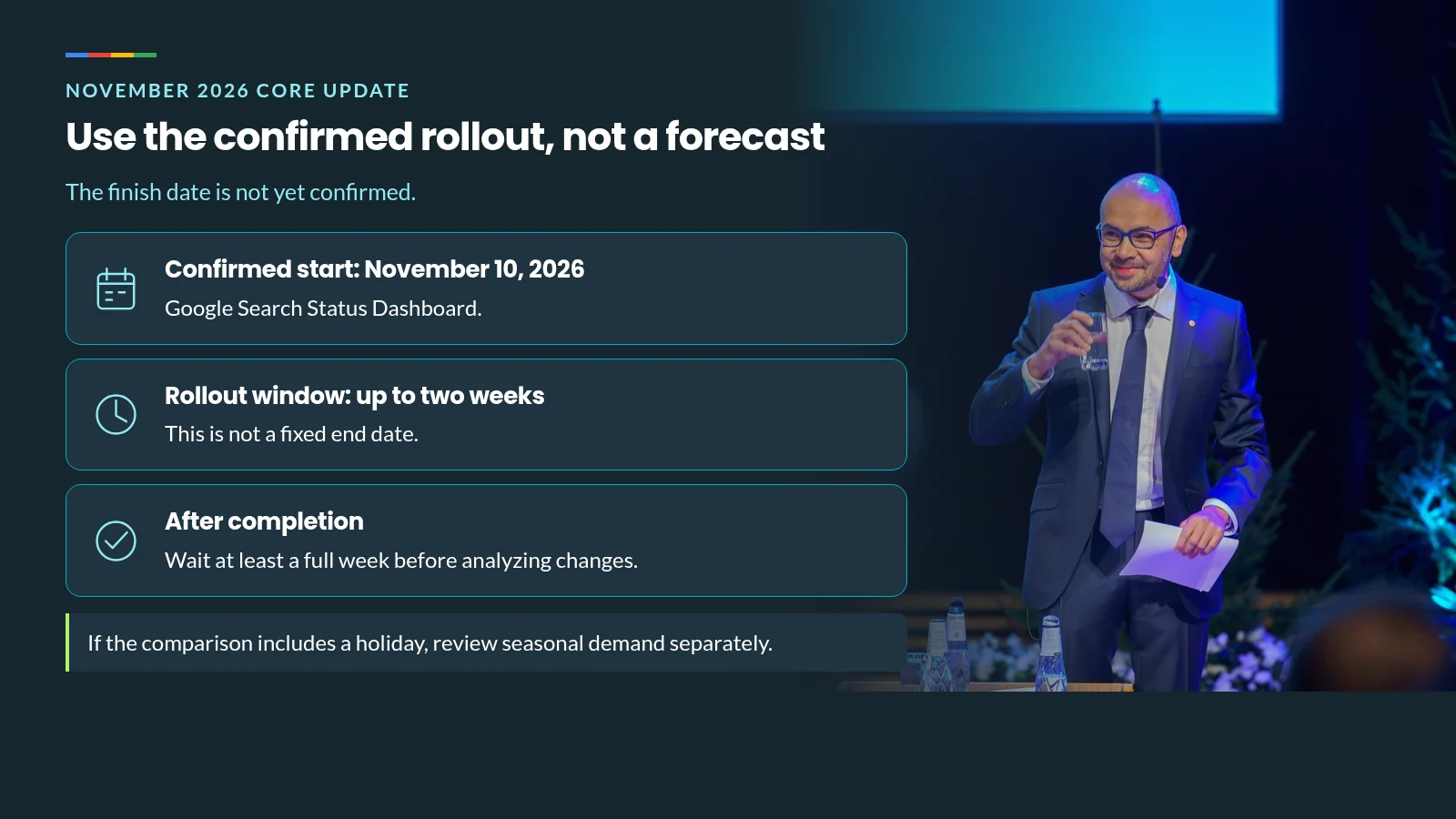
This Google algorithm update arrived more than five months after the May 2026 core update finished. That is the longest pause between announced core updates so far in 2026. In between, Google ran spam updates in June, August, and September 2026. The November release is a core update, not a spam update, and Google has not published a Search Central blog post that adds new, narrower goals for it.
The calendar also matters. If the rollout takes the full two weeks Google mentioned, it may finish around November 24, 2026. That date sits just before U.S. Thanksgiving, Black Friday, and Cyber Monday. Retail and ecommerce sites comparing the week after the rollout with a normal week in early November may be comparing holiday demand with everyday demand. That can make a traffic change look larger, or smaller, than the update itself caused.
Google’s current core-update guidance is to wait at least a full week after the rollout is complete, then compare that week in Search Console with a week from before November 10, 2026. If the rollout runs to about November 24, that comparison week may overlap the holiday period. In that case, also look at the same holiday window from a prior year, and separate branded, non-branded, and product-category queries, so seasonal demand is not mistaken for a ranking change.
This does not mean you should ignore the data now. Record it, keep the comparison windows clean, and wait to make large decisions until the update has finished and you have a fair baseline. Treat those numbers as a running log, not a final score. Early swings are still only part of the story.
How to Check if Your Website Was Affected
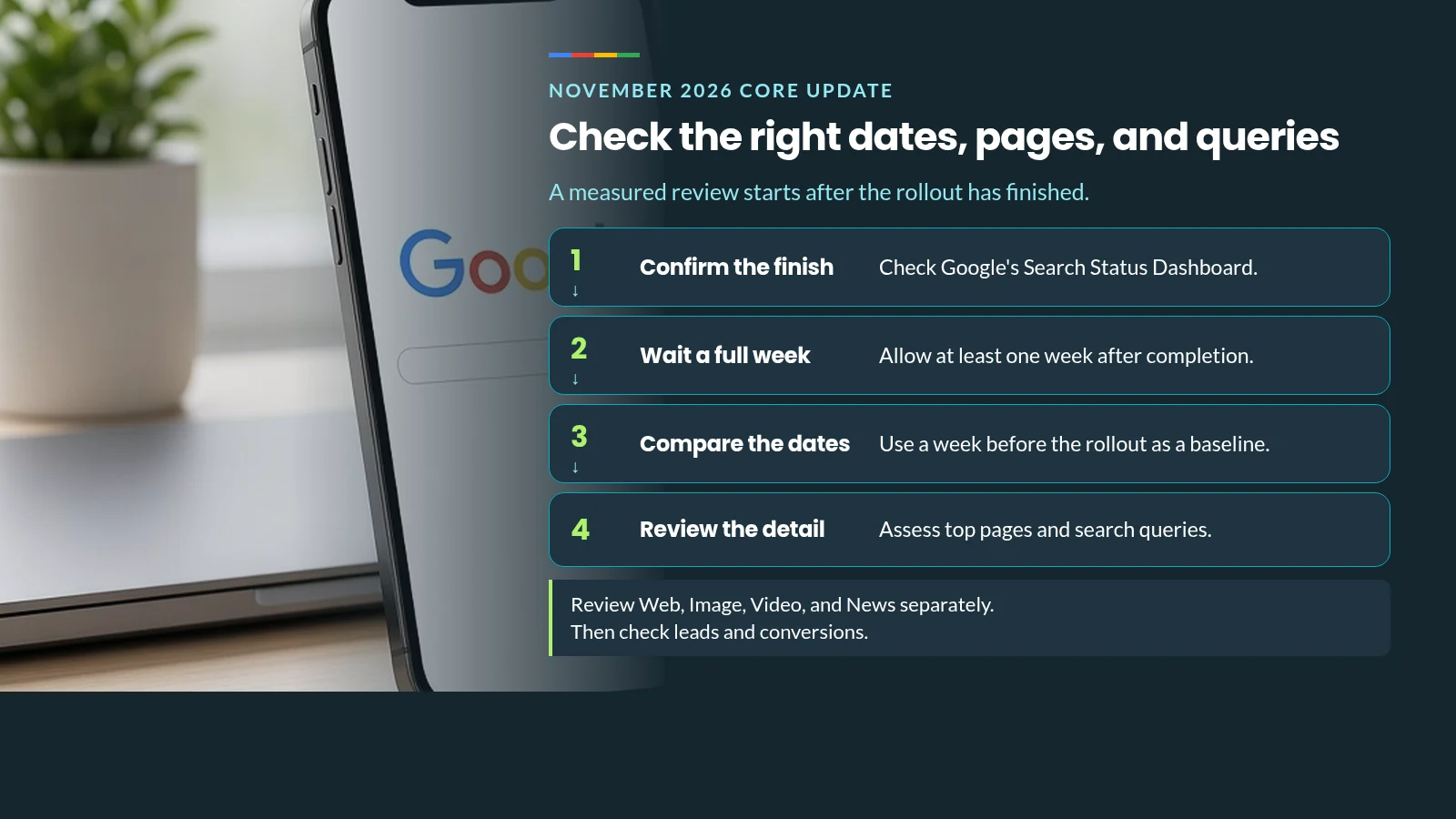
Wait for the rollout to finish before making big decisions. You can still monitor performance during the rollout, but treat early movement as a signal to watch, not a final verdict. If you make major changes too quickly, you may create new problems before you understand what actually happened.
Use Google Search Console as your first review point. Compare the weeks before November 10, 2026, with the period after the rollout is complete, and then with at least one full week after that. Look at clicks, impressions, average position, and click-through rate by page and query. Do not rely solely on total traffic, as sitewide numbers can mask gains and losses across sections.
A practical review should go below the sitewide totals. Look at the items below, one by one. This is the list we use first:
- Pages with the largest non-branded click changes
- Queries that lost impressions but kept similar rankings
- Queries that kept impressions but lost clicks
- Pages that lost rankings for high-intent terms
- Pages that gained visibility and may deserve more internal support
- Conversion changes by landing page
- Search result changes for priority keywords
- Web, Image, Video, and News search, reviewed separately
Then check GA4 or your analytics platform. Search Console shows search visibility, but analytics shows what users did after they landed on the site. A page that lost lower-quality traffic may not hurt the business. A page that lost fewer visits but more qualified leads deserves closer attention.
It is also worth grouping pages by intent. Service pages, blog posts, location pages, comparison pages, and product pages often respond differently during a core update. A blended sitewide review can send teams in the wrong direction. Page groups make the patterns easier to understand. Review each group on its own before you draw a sitewide conclusion.
What Not to Do During a Google Core Update
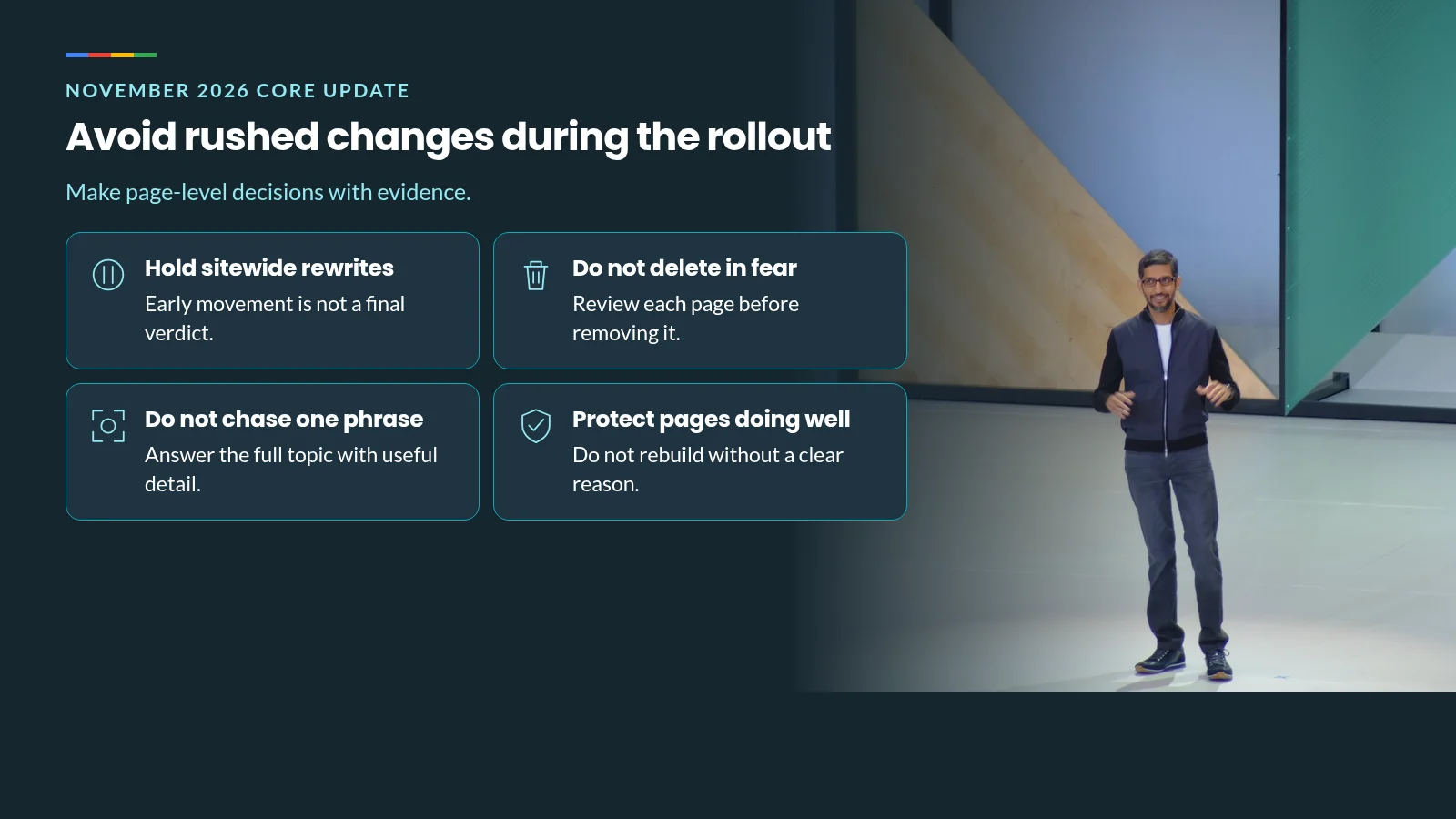
Do not make large edits to every page just because rankings shift for a few days. Core algorithm update movement can change throughout the rollout. Give the update time to finish before you treat a swing as permanent.
A page that drops early may recover. A page that rises early may settle back down. Acting too fast can make your data harder to read. That kind of swing is common while a broad update is still rolling out.
Avoid deleting old content without a page-level reason. Some older pages may still support topical relevance, internal links, long-tail traffic, or buyer research. If a page is thin, outdated, duplicative, or no longer useful, it may need improvement or removal. But base the decision on data and content review, not fear. Make that call one page at a time.
Do not chase one keyword at the expense of the full topic. Google’s systems are better at understanding related questions, searchers’ needs, and page usefulness. A page built around one phrase with little substance will usually be weaker than a page that answers the topic with clarity, examples, proof, and a useful next step.
Also, avoid changing content that is already doing well. If a page gained visibility, held steady, or continues to produce qualified leads, protect it. You can improve internal links, add updated proof, or make small clarity updates. Do not rebuild a winning page without a clear reason.
What to Improve After the November 2026 Core Update
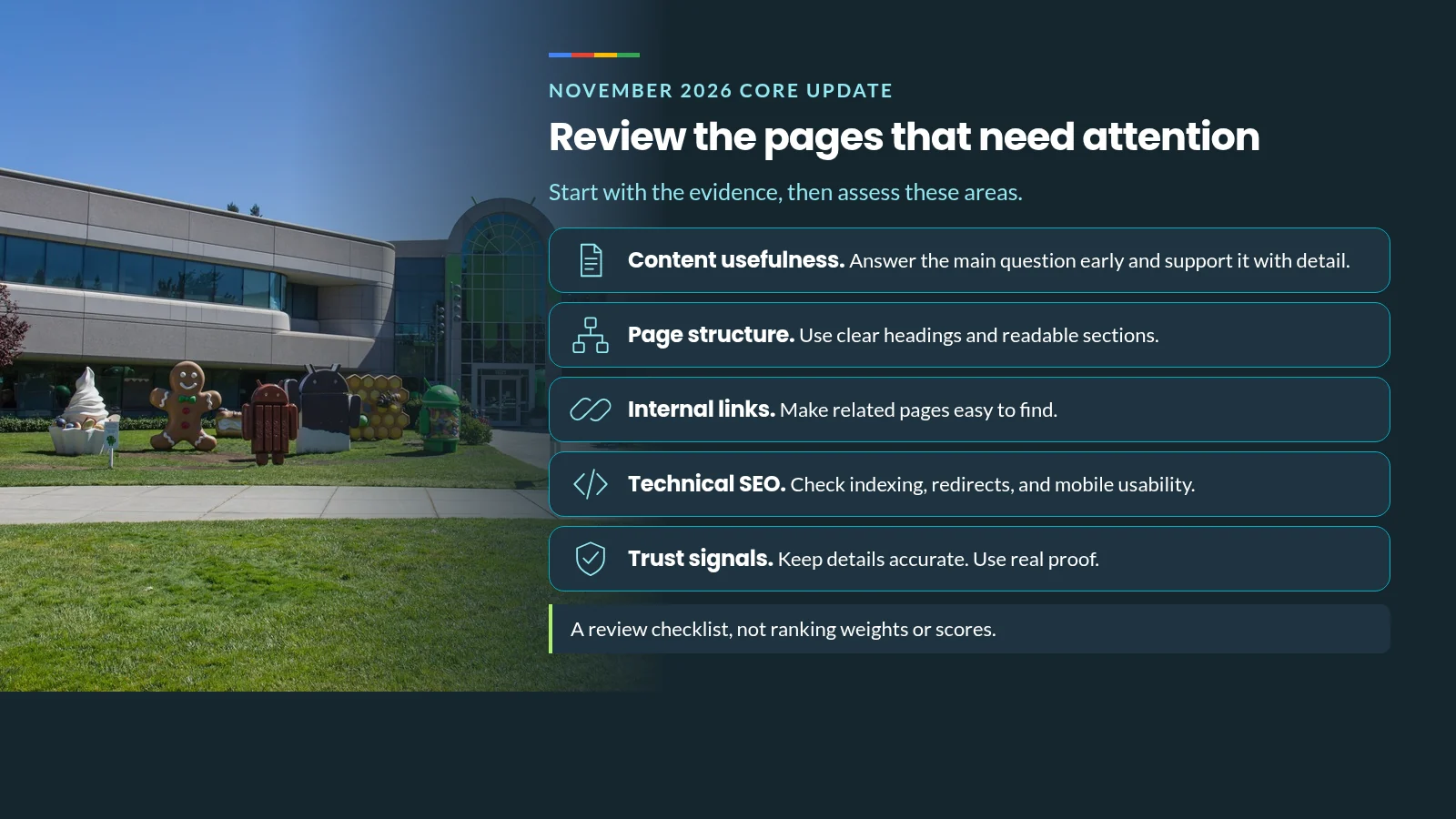
After the November 2026 core update finishes, focus on pages where performance changed in ways that affect the business. A good review does not ask, “What can we edit?” It asks which URLs show a mismatch between search demand, page quality, and business value. Start there, not with a sitewide rewrite.
Start with content usefulness. Look at whether the page answers the searcher’s main question early, then supports that answer with enough detail. Strong content usually has a clear point of view, practical examples, source-backed claims, and a structure that helps readers move through the page without confusion. Thin pages that mostly repeat a keyword rarely hold up in that kind of review.
Next, review page structure. Headings should make the content easy to scan. Important answers should not be buried near the bottom. Paragraphs should be readable, and sections should build on each other. Good structure helps users, search engines, and AI-driven systems understand the page more easily.
Internal linking also deserves attention. Pages that matter most to the business should receive clear internal links from related pages. The link text should describe the destination page in plain language. That helps distribute authority, guide users, and make site relationships easier to understand.
Technical SEO should be part of the review, especially if affected pages share common issues. Check indexing, canonical tags, redirects, mobile usability, page speed, schema, broken links, and JavaScript rendering. A strong page can still underperform if Google cannot access, process, or understand it well.
Finally, review trust signals. Keep service details accurate. Use real examples, case studies, data, testimonials, process explanations, or product details when they help the reader make a decision. Generic content is easier to replace. Specific, useful, experience-based content is harder to ignore.
How to Read SEO Results During a Holiday Rollout
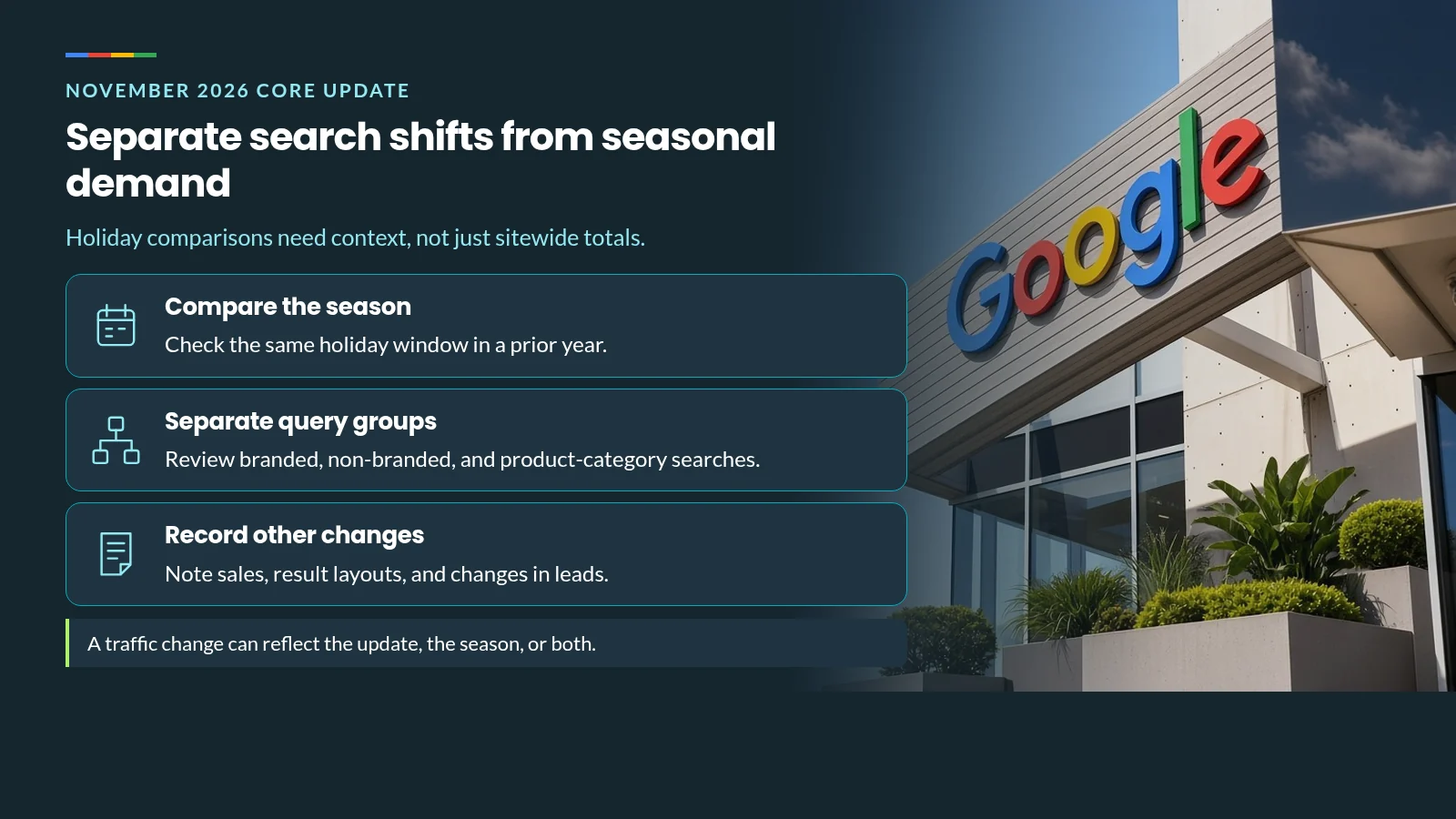
The November 2026 core update may still be rolling out during a period when many businesses already expect traffic to change. That makes measurement harder than it is in a quiet month. A rise in clicks on a product or offer page may be seasonal. A drop on an informational blog post may be due to an update, a change in the search result, or both.
A traditional core update review still looks at rankings, clicks, impressions, and landing page traffic, and that work remains the foundation of SEO. You should also ask whether the search result itself changed. If AI Overviews, AI Mode, answer-style results, local packs, video, shopping modules, or other features shift, clicks can change even when rankings do not tell the whole story.
That does not make organic traffic less important. It means organic traffic needs more context. A good SEO report should show rankings, clicks, impressions, landing page performance, conversions, and changes in search results. It should also call out where the comparison window includes a holiday, a sale, or another event that would have moved traffic on its own. If the result layout changed, note that next to the traffic change.
For businesses, the measurement model should stay close to the pipeline. Did visibility lead to qualified traffic, and did that traffic lead to calls, forms, demos, subscriptions, or sales conversations? Did content assist buyers who later returned through paid search, direct traffic, email, or branded search? Those questions matter more than a single keyword moving up or down.
What Digital Results Recommends Next
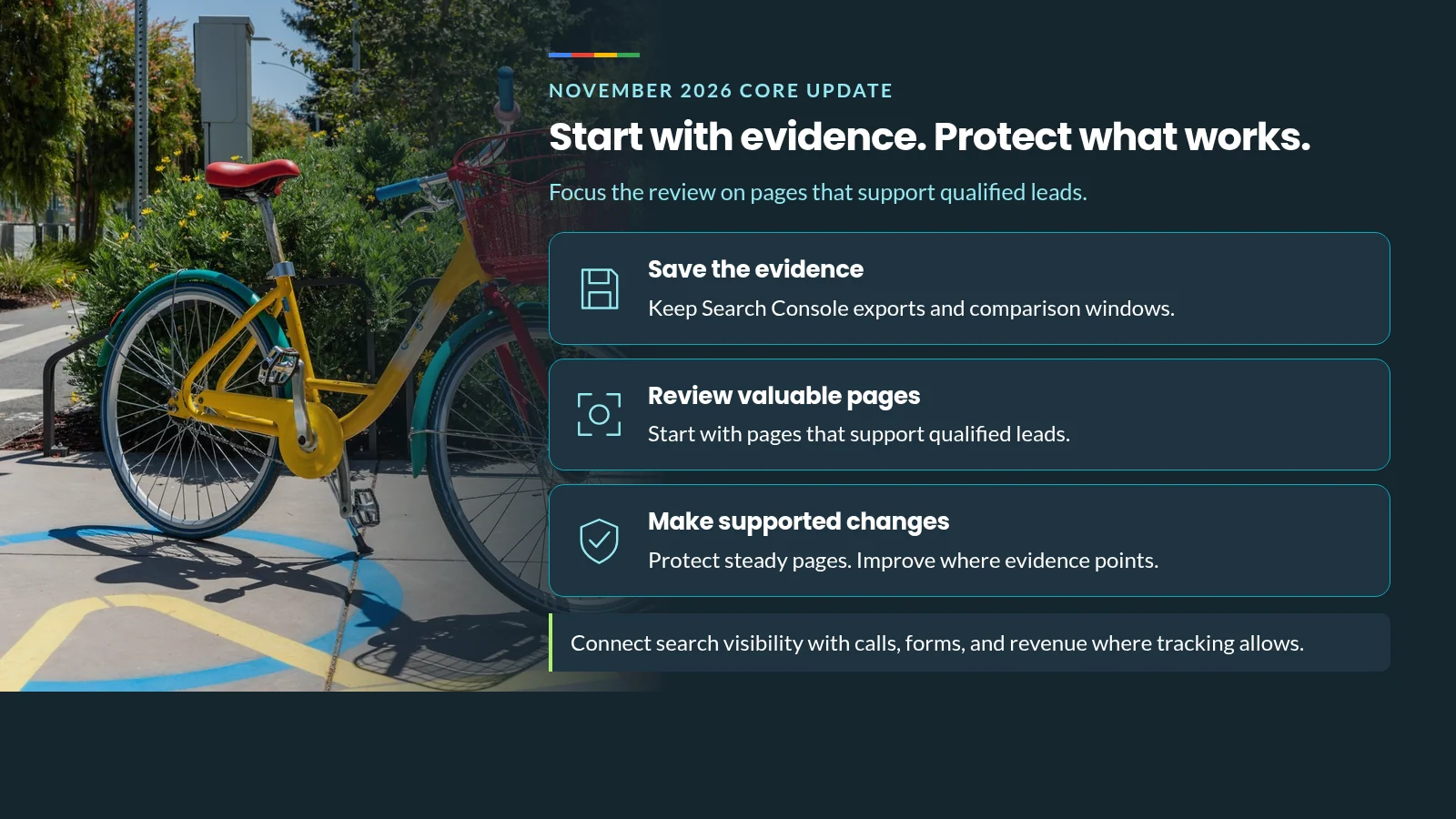
The best response to the Google November 2026 core update is a focused review after the rollout is complete. Watch the data now, build your comparison windows, and save current rankings and Search Console exports. Then review the actual movement once the update has finished.
Start with your highest-value pages. These are usually service pages, location pages, product pages, comparison pages, and blog posts that support qualified leads. If those pages held steady, do not overwork them. If they dropped, review them against the pages now winning in search.
Then look for content that has become too generic. A page that mainly repeats what other sites already say is at risk in both traditional search and AI-shaped search results. Add useful detail, first-hand insight, clearer answers, better structure, and stronger proof where it helps the reader.
You should also review your reporting. This rollout sits close to a major shopping period. SEO reports need to go beyond rankings and show whether a change followed the update, the season, or both. Strong reporting should connect search visibility to leads, call quality, form quality, booked appointments, and revenue, where tracking allows.
If your site changed during the November 2026 core update, start with the data. Protect what is working, and improve the pages where better content, stronger structure, or technical cleanup can make a measurable difference. That is how businesses should respond to a core update in 2026. Digital Results can help with that review from our Reno/Tahoe HQ. If you want a second set of eyes on your most important pages, schedule a consultation.
What Google has Said
| Feature | Details |
|---|---|
| Launch date | November 10, 2026, 10:06 a.m. Pacific Time |
| Rollout duration | Up to 2 weeks (still in progress as of 7:29 a.m. Pacific Time on November 11, 2026) |
| Scope | Global, across all languages |
| Impacted product, per the dashboard | Ranking |
| Google’s description | A regular update designed to better surface relevant, satisfying content for searchers from all types of sites |
| After the rollout | Google said it will update the ranking release history page when the rollout is complete |
Topic Coverage Becoming More Important
| Old approach | Newer direction |
|---|---|
| Focus on getting more backlinks | Focus on covering a topic completely |
| Publish many separate short articles | Build fewer but stronger and deeper pages |
| Target individual keywords | Build authority around entire topics |
Google November 2026 Core Update FAQs
What is a Google core update?
A Google core update is a broad change to Google’s ranking systems. It can affect how Google evaluates pages across many topics and industries. It usually isn’t aimed at a single site or a single type of violation. A page can move up or down because Google is reassessing what content best answers a searcher’s need.
How do I know if the November 2026 core update affected my website?
Check Google Search Console after the rollout is complete. Compare performance from before November 10, 2026, with performance after the update finishes, including at least one full week after completion. Review clicks, impressions, average position, and click-through rate by page and query. Then compare those changes with leads, calls, forms, and revenue-related actions in your analytics platform. If your business is seasonal, compare the same week against a prior year as well.
Should I update my content during the rollout?
It is usually better to wait before making large changes. You can document movement and review affected pages during the rollout, but major edits should wait until you have a fuller picture. Small fixes for obvious errors are fine. Base full rewrites, content removals, and sitewide changes on post-rollout analysis.
How do you recover from a Google core update?
Recovery starts with finding which pages and queries changed. Then review those pages for usefulness, accuracy, structure, internal links, technical issues, and trust signals. The goal is not to trick the algorithm. The goal is to make affected pages more useful than competing results for the searches that matter to your business. Google has also noted that some recovery can appear between core updates, and that larger changes often follow a later core update.
SEO Tracking Tools On the November 2026 Core Update
On November 11, 2026, MozCast’s public page showed a temperature of 123° and a Stormy icon for Tuesday, November 10, 2026. MozCast describes that figure as a weather report of turbulence in the Google algorithm over the previous day. A November 11 reading was not on the page yet. That is a MozCast reading, not a Google statement.
Background photographs: Demis Hassabis at the 2024 Nobel Lectures, Jay Dixit, CC BY-SA 4.0, via Wikimedia Commons, cropped and faded, used on the hero, timing, and share card images. Sundar Pichai at the Google I/O 2017 Keynote, Steven Zimmerman, CC BY-SA 4.0, via Wikimedia Commons, cropped and faded. Android lawn statues at the Googleplex, Atomic Taco, CC BY-SA 2.0, via Wikimedia Commons, cropped and faded. Google bikes, Mountain View, 2022, Dietmar Rabich, CC BY-SA 4.0, via Wikimedia Commons, cropped and faded. Campus, Search, and signage backgrounds are AI-generated illustrations.